
Production Guides
By Taylor Andrew, Partner & Head of Project Services, Spexster
Talent Release Forms and Location Releases: What Brands, Agencies and Crews Need in 2026
A talent release is a person's signed permission to use their name, likeness and voice for stated purposes; a location release is a property owner's signed permission to film there and use what you capture. For any commercial use, get both in writing before the camera rolls, scoped to the media, territory and term you need, with an explicit clause on AI and digital replicas.
The video is live. Then someone in it asks you to take it down.
It is the call every marketing team dreads and most eventually get. The customer story has been running in paid social for two months. The customer has left the company, or fallen out with it, or simply changed their mind, and they want it gone. Or a former employee's face is on a billboard and their lawyer has noticed. Or the beautiful shot of the storefront turns out to be someone else's storefront.
Whether you can say "sorry, you signed a release" or have to pull a campaign comes down to a piece of paper that takes two minutes to sign on the day and is almost impossible to get afterwards. This guide covers what a talent release and a location release each do, what a solid one actually says, who collects them on a shoot, and the part that has changed most in the last two years: what a release has to say about AI. If you hire through Spexster, who collects the paperwork is settled before the shoot; the last section explains how.
This article is general information for planning a shoot, not legal advice. Release language and likeness laws vary by state and country; have a lawyer review your forms for your project and jurisdiction.
Talent release vs location release: what each one does
Both turn "they said it was fine" into written proof of permission, but they protect different things.
| | Talent release (model or appearance release) | Location release (property or location agreement) | |---|---|---| | Who signs | Each recognizable person on camera or on the audio; a parent or guardian for a minor | The owner, or a manager with written authority to grant access | | What it covers | Use of name, likeness, voice and performance | Access to the property and use of footage showing it | | When you need it | Any commercial use of an identifiable person | Filming on private property, or showing a recognizable private property in commercial work |
The legal stakes for people are real. New York's Civil Rights Law Section 50 makes it a misdemeanor to use a living person's name, portrait, picture, likeness or voice "for advertising purposes, or for the purposes of trade" without their written consent, or a parent's or guardian's for a minor. California Civil Code Section 3344 gives people a claim for knowing use of their name, voice, photograph or likeness in advertising without prior consent, with damages of at least $750 or actual damages, whichever is greater.
What a solid release includes: a checklist
Releases fail on vague wording more than on missing signatures. Check that each form covers:
Talent release
- Legal name, contact details and date of birth (to confirm the signer is an adult)
- Project, client or brand, and shoot date
- What is granted: likeness, voice, name and performance
- Media and channels: broadcast, online, social, out-of-home, print, internal
- Territory and term, such as worldwide and perpetual, or a set number of years
- Right to edit and combine the footage with other material
- Compensation or other consideration
- AI and digital replica terms (see below), stated separately
- Signature, printed name and date; parent or guardian for minors
Location release
- Property address, and the signer's name, role and authority to grant access
- Dates and hours, including prep and strike, and the areas included
- Whether signage and the property's name may be shown
- Use rights for the footage, matching the talent release
- Crew and vehicle count, parking and equipment limits
- Insurance, damage and restoration
- Signature, printed name, title and date
Match the scope across both forms and the crew contract: if the talent release says "social media only" and the client later runs a TV spot, it is not covered.
Minors
A minor cannot give their own valid consent on a release: both New York's Section 50 and California's Section 3344 require the parent or guardian's consent for a minor, and stock libraries such as Shutterstock require the parent or guardian, not the child, to sign.
Several states also regulate children working on camera. In California, minors from 15 days to 18 years old working in entertainment need an entertainment work permit, and the employer needs a permit to employ minors, per the state's labor standards office. In New York, print and runway models under 18 need a Child Performer Permit, and the employer needs a Certificate of Eligibility and must notify the Department of Labor at least two days before the shoot. Our guides to filming in Los Angeles and filming in New York City cover local permits.
Crowds, public places and commercial vs editorial use
Commercial use promotes a product, business or service. Shutterstock's contributor rules for commercial content require a signed model release from every recognizable person and property releases for recognizable private property. Adobe Stock says that if a person "can be recognized in any way, by their face, voice, tattoos, clothing, or even specific surroundings," get a release.
Editorial use serves news, education or documentary purposes and generally needs no model or property releases on stock platforms.
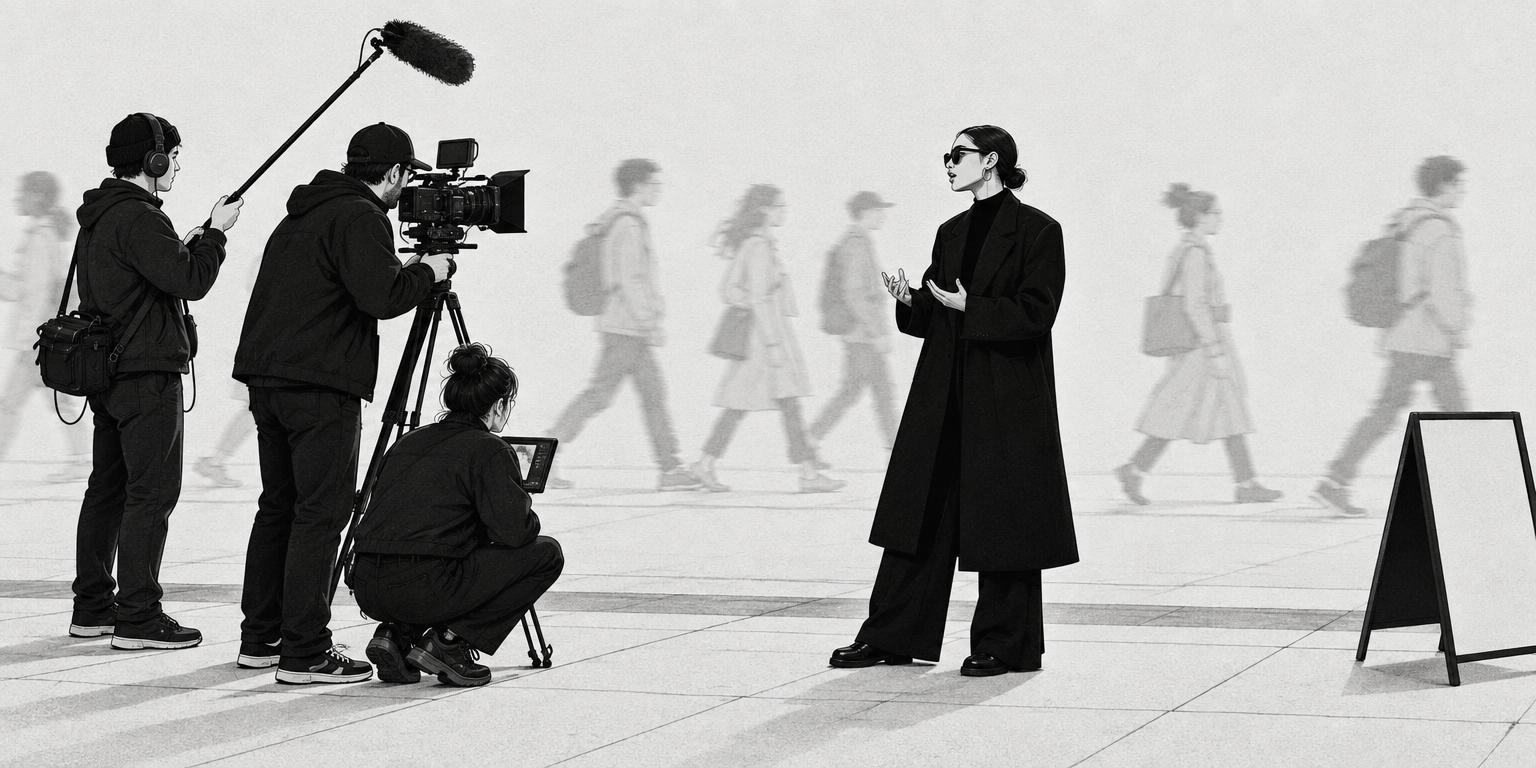
For brand work, treat everything as commercial: release anyone featured, keep background people unrecognizable, or cast and release extras. A posted filming notice is good practice, but not a substitute for a signed release from anyone featured or clearly identifiable.
On buildings: US copyright law (17 U.S.C. Section 120(a)) does not let an architect's copyright stop photos of a constructed building that is in or ordinarily visible from a public place. That covers architecture only; logos, artwork and filming on private land or inside still need permission.
Drone and aerial shoots
The FAA's Part 107 rules on operations over people cover safety, not consent, and say nothing about releases. Recognizable people or private property in aerial footage raise the same release questions as ground footage. When you hire a drone operator, list takeoff and landing spots in the location release. Browse drone operators on Spexster.
Digital signing
Under the federal E-SIGN Act (15 U.S.C. Section 7001), a signature or contract in interstate commerce "may not be denied legal effect, validity, or enforceability solely because it is in electronic form," so signing on a tablet is normal practice.
Two cautions. Shutterstock requires signatures "digitally written with a stylus pen or finger on a touch-screen device" or in ink, so a typed name may not pass if footage is headed for stock. And make each record easy to match to a person: timestamp, contact details and, on many productions, a reference photo of the signer. Store the set with the project files, not on one crew member's phone.
Who on the shoot collects releases
Decide this in writing before the shoot.
- Crewed production: the producer owns it. A production coordinator or assistant director typically collects talent releases at check-in; location agreements are signed before the shoot date.
- Solo or small crew: the videographer or photographer is often asked to collect them. Put that in the brief and supply client-approved forms.
- Agencies: agree who holds the signed originals, and make sure the release names the end client.
At wrap, one person checks every featured face against a signed form. On multi-location work, like Madden Media's shoots across four US destinations through Spexster, that check happens in each location.
AI, likeness and digital replica clauses
A digital replica is a realistic, computer-generated version of a real person's voice or likeness. This is where the rules have changed most.
- California (AB 2602), effective January 1, 2025, makes a contract provision unenforceable if it allows a digital replica in place of work the person would otherwise have done in person, lacks a "reasonably specific description" of the intended uses, and the person did not have legal representation covering digital replicas.
- New York (S7676B), effective January 1, 2025, sets similar conditions for contracts made or modified after that date.
- Tennessee's ELVIS Act, effective July 1, 2024, added voice to the state's likeness protections, aimed at AI voice clones.
- New York's synthetic performer disclosure law, in effect since June 9, 2026, requires ads that include AI-generated synthetic performers to disclose it.
- SAG-AFTRA's 2025 Commercials Contracts, effective April 1, 2025, require clear and conspicuous consent based on a reasonably specific description of the use, given in the Digital Replica Rider or another writing separate from the employment contract, with notice before creation or use and separate pay for it.
- The federal NO FAKES Act of 2026 (S. 4591) cleared the Senate Judiciary Committee in June 2026 but had not become law at the time of writing.
For your forms: do not assume a general "any technology now known or later developed" grant covers a digital double. If you want AI options, put them in a separate, specific clause the performer signs, and route union talent through the union's terms. If you have no plans for AI use, say so.
How Spexster fits
Releases get missed for a boring reason: nobody was told it was their job. On a Spexster hire that question is answered before the shoot. Contracts run through the platform, and with White Glove a dedicated project manager handles the technical briefings, scheduling and logistics around the shoot day, including who collects releases and with which forms, at no additional fee. Payment runs through escrow powered by Stripe and is released when the work is delivered. On multi-location work like Madden Media's shoots across four US destinations, that check happens in each city, every time.
Every professional on Spexster is vetted before appearing, with no paid placement. Start with the crew page for the city where you are shooting, or post a job. Or send a brief and our White Glove team will coordinate the release paperwork with you.
Frequently asked questions
Do I need a talent release for a company employee in our own video?
It is the safe course. Do not rely on employment alone as permission to use someone's likeness in advertising, and you will want to keep using the video after they leave.
What is the difference between a model release and a talent release?
Very little. "Model release" is common in photography and stock, "talent release" or "appearance release" in video. What matters is who signed and what uses are granted.
Do I need a location release to film in a public park or street?
Not from an owner, but most large cities require a film permit for commercial shoots on public property. Our guide to filming in London covers the UK side.
Is an electronic signature on a release legally valid?
In the US, the E-SIGN Act says a signature cannot be denied legal effect solely because it is electronic. Some stock platforms require a drawn signature rather than a typed name.
Does a standard release cover AI use of someone's likeness?
Do not assume it does. California and New York now make vague digital replica clauses unenforceable in some contracts, and SAG-AFTRA requires separate, specific consent.
Sources
- New York Civil Rights Law Section 50 – Justia
- California Civil Code Section 3344 – Justia
- What is the difference between Commercial and Editorial content? – Shutterstock Contributor Support
- Content Publishing Standards: Legal Documentation – Shutterstock Contributor Support
- Model releases in Adobe Stock – Adobe Help
- Minors Employed in the Entertainment Industry – California DIR, DLSE
- Child Model Frequently Asked Questions – New York State Department of Labor
- 17 U.S. Code Section 120 – Cornell LII
- Operations Over People – Federal Aviation Administration
- 15 U.S.C. 7001: General rule of validity – US House Office of the Law Revision Counsel
- California Enacts Generative AI Law Addressing "Digital Replicas" of Performers – Proskauer
- NY Senate Bill S7676B – New York State Senate
- Tennessee Law Designed to Combat Deepfakes Set to Take Effect in July – Alston & Bird
- Governor Hochul Announces Synthetic Performer Disclosure Law Is in Effect – New York State
- Contract Bulletin: A.I. and Commercials (June 2025) – SAG-AFTRA
- Importance of Digital Replica Consents Under the SAG-AFTRA Commercials Contract – Davis+Gilbert
- Senate Judiciary Committee Advances Legislation to Protect Name, Image, Likeness and Voice – Holland & Knight