
Hiring Guides
By Taylor Andrew, Partner & Head of Project Services, Spexster
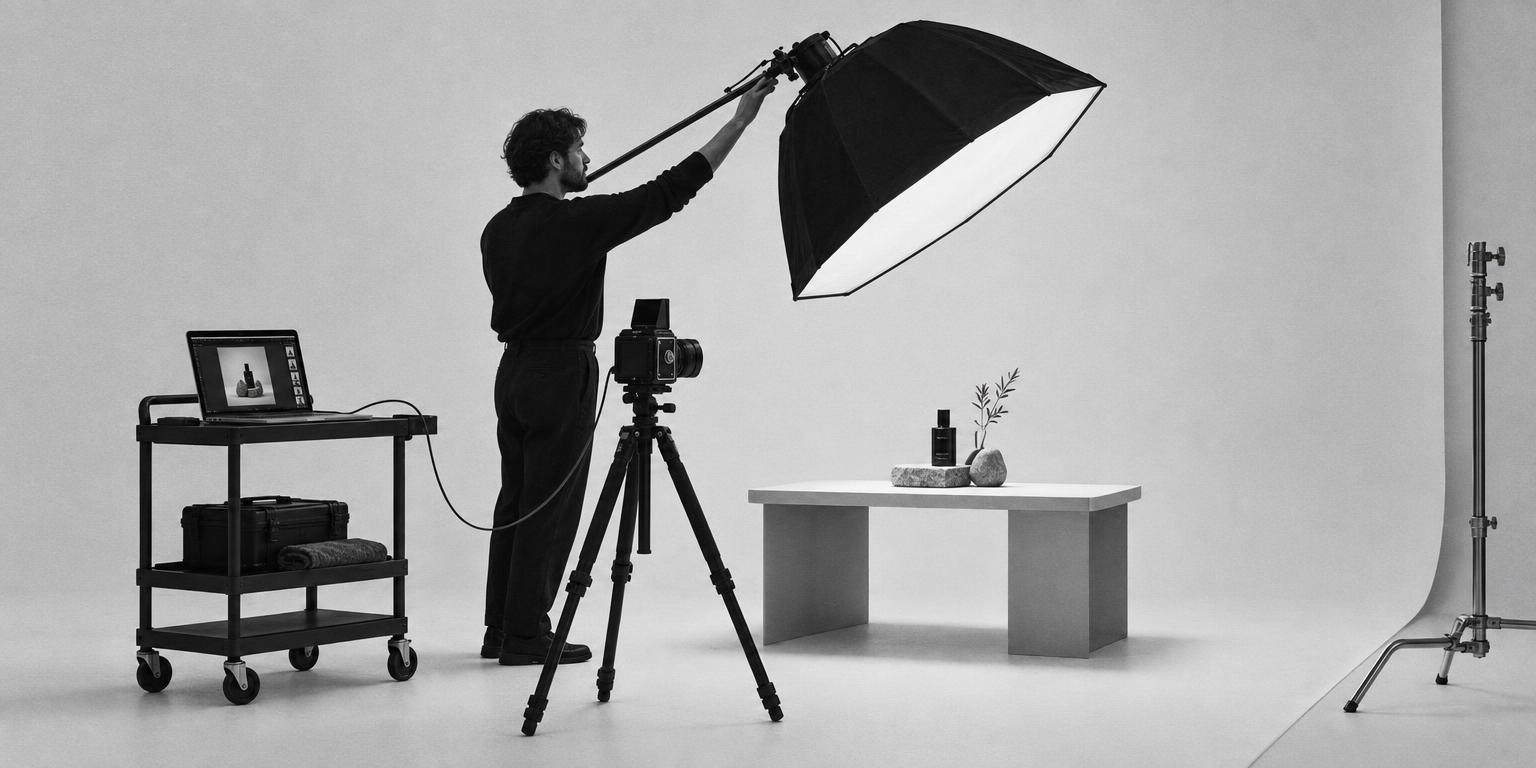
How to Hire a Commercial Photographer for Your Brand
Name the specialty first (product, headshots, events, brand lifestyle, real estate or food), then shortlist photographers whose portfolios show a whole job in that category, not three great frames. Brief the shot list and where the images will run, agree the usage licence in writing before the shoot, and post the brief where vetted photographers apply to you rather than the other way round.
Every portfolio looks good. That is the problem.
Nobody hires a commercial photographer whose work looks bad. The failures happen the other way: a photographer whose lifestyle images stopped you cold turns out to need a full day for twelve product shots, and the e-commerce range you briefed arrives inconsistent and late. Or the headshots are lovely individually and look like six different companies on the leadership page. Or, most common of all, the images are perfect and six months later the marketing team drops them into a paid campaign and discovers that was never licensed.
The photographer was good. They were the wrong kind of good, or the paperwork never said what you were buying. This guide is about avoiding both: how to name the job, how to read a portfolio for the thing that matters, and how usage rights actually work. The last section covers the shortcut.
The six commercial photography specialties
These map to the photographer specialisations you can filter by on Spexster, and the first decision is which one you need.
### Product and e-commerce
Repeatable images of goods on a fixed background, shot to a spec so every SKU matches on the product page. Look for a product photographer who works tethered with a standardised setup and delivers at volume with clean clipping paths. Brief the SKU list, angles per product, background, and the exact pixel dimensions and file format your storefront needs.
### Headshots and team
Portraits for websites, press and LinkedIn. The skill is putting non-models at ease and lighting every face the same way, so the leadership page looks like one set. A corporate headshot photographer should show you a full team gallery, not the best three frames. Brief the headcount, background, crop, wardrobe guidance and whether you want a matched wall or a looser editorial style.
### Events and conferences
Documentary coverage of keynotes, panels, sponsor activations and networking, often in poor light. An event photographer needs fast, reliable technique and a delivery plan for the day. Brief the run of show, must-have moments (speakers, sponsor logos, awards), priority people, and whether you need same-day selects for social.
### Brand and lifestyle
Art-directed imagery showing your product in use or your team at work. It is closest to a small film shoot and may need talent, styling, a location and a producer. A brand photographer should show mood boards translated into finished sets. Brief the mood, references, talent, location and channels.
### Real estate and architecture
Interiors and exteriors for developers, hotels and architects. The craft is verticals that stay vertical, balanced window light, and waiting for the right hour. Brief the property list, the rooms and angles that matter, whether you want twilight exteriors, and whether the images are for listing, editorial or advertising use.
### Food
Menus, packaging and social for restaurants and CPG brands. Food photographers often work with a food stylist. Brief the dishes, the style (bright and clean versus dark and moody), whether a stylist is included, and the formats for menu, web and social.
How to write a brief a photographer can price
A good brief removes guesswork and gets you a faster, more accurate quote. It is also what lets the right photographer recognise the job as theirs. Cover six things:
- Shot list. Every image, grouped by setup, with essentials separated from nice-to-haves.
- Usage. Where the images will run (website, social, paid ads, print, packaging), in which territories and for how long. This drives the licence and the price, so state it up front.
- Formats. Aspect ratios and sizes per channel, file type, and whether you need layered files.
- Retouching expectations. Basic clean-up versus full compositing, and how many revision rounds are included.
- Turnaround. When you need selects and when you need finals.
- Logistics. Studio or location, dates, who attends from your side, and who signs off on set.
Include references, and say what you like about each one.
How to read a photographer's portfolio
A portfolio is a sales tool, so read it the way a producer would.
Consistency. Look at ten images in a row. Do they share one standard, or is it one great shot and nine ordinary ones? For product, headshots and real estate, consistency is the job.
Lighting control. Can you see that the photographer decided where the light came from? Clean highlights on glass, even skin across a group portrait and balanced windows in an interior are signs of control.
Work in your category. A strong lifestyle photographer may not have the volume workflow for 300 SKUs. Ask to see a complete job, not selects: a full team gallery, a whole e-commerce range, an entire event. This one request tells you more than the whole website.
Usage rights and licensing, explained plainly
This is the part most buyers skip, and it causes the most disputes.
Under US copyright law the photographer owns the copyright in the images they create unless the work is a "work made for hire." The U.S. Copyright Office explains that a commissioned work only qualifies if the parties expressly agree in a signed written instrument that it is a work made for hire, and the work falls into one of a limited set of categories. Most commissioned photography does not, so in practice you are buying a licence, not the copyright.
The American Society of Media Photographers (ASMP) describes a licence as a permission slip that defines "exactly how, where, and for how long someone can use your work," set by four parameters: type of usage (advertising, editorial, corporate), exclusivity, term and territory. One ASMP-published headshot licence reads "Public relations use and electronic usage on the .com website for a period of two years. No advertising usage," with all other rights reserved. The American Photographic Artists (APA) Business Manual draws the same line between licensing and a "buyout," and supplies template model and property releases.
What this means for you:
- Name every use you can foresee. If you might run the images in paid social next year, licence it now. Extending later usually costs more than including it at the start.
- Get the licence in writing, on the estimate and the invoice, with media, term, territory and exclusivity spelled out.
- A buyout or copyright assignment is an option for imagery you will use indefinitely, but it needs a written agreement.
- Releases are separate from the licence. One set of photographer terms published in ASMP's licensing guide states that no model or property release exists unless the photographer supplies one in writing. If people or private property appear in commercial images, confirm who is obtaining releases.
Through Spexster, the usage terms go into the platform contract before the shoot, which is the whole point: the question gets asked once, in writing, by someone who asks it every week.
Questions to ask before you book
- How many rounds of retouching are included, and what counts as a round?
- Do you deliver RAW files? Many photographers do not, and that is normal; agree it now, not after the shoot.
- How do you back up on the day? Dual card slots and a same-day copy is a reasonable expectation.
- Who handles model releases for talent and staff?
- Do you carry liability insurance, and can you provide a certificate if the studio or venue requires one?
- Who else is on the crew, and who books them?
Studio or location?
A studio gives you controlled light, power and predictable results, and is the default for product, food and matched headshots. Location gives context for brand, lifestyle and real estate work, at the cost of weather, permits, access and travel time. For a mixed job, shoot headshots and product in a studio on day one and lifestyle on location on day two. A local photographer will know which locations need a permit.
Hiring a commercial photographer by city
For most brand work a local photographer is the efficient choice: they know the studios, the light and the permit situation, and you are not paying for travel days. Spexster's Crew Map lets you browse vetted commercial photographers by location, and each city hub narrows to the role, so you can go straight to photographers in New York or the equivalent for Los Angeles, Atlanta, Toronto, Vancouver or London.
The same applies when the shoot is in several cities: hire locally in each one. Out-of-home media company DIVE Billboards used Spexster to source local photo and video crews across 13 countries and 45+ cities, most shoots on around a two-week turnaround from brief to delivery. The DIVE Billboards case study shows how that works in practice.
How Spexster fits
You can run everything above yourself, and if you do, you will hire well. What Spexster changes is who carries it.
Post the job with the shot count, the specialty and where the images will run, and vetted photographers apply. Every photographer on the platform has been reviewed before appearing (portfolio, credits and professional presence, no paid placement), and you are reading complete portfolios from people who already want the job, not guessing from a website.
Or send the brief and a dedicated White Glove project manager finds the right specialist, agrees the usage rights in the contract and manages the day, at no additional fee. Payment runs through escrow powered by Stripe, released when the images are delivered. Briefs typically get a response within one business day. Start with photographers for hire.