
Hiring Guides
By Taylor Andrew, Partner & Head of Project Services, Spexster
How to Hire a Film Crew in Another City: A Brand's Guide to Remote Shoots
Hire people who already work in that city rather than flying your own team in, brief them in writing with a numbered shot list and a named approver, and direct the day over a live remote video village so you see the camera monitor as it records. Lock the technical spec before anyone rolls so footage from several cities cuts together, and run contracts and payment on escrow.
The shoot is in Atlanta. You are in Toronto. Now what?
Every growing brand hits this moment. A customer story is in Atlanta, a store opening is in London, a campaign needs the same interview shot in five cities, and the crew you trust is here. The reflex is to fly them. The flights get booked, then the hotels, then the per diems, then the question of how a cinema camera and a lighting kit get through an airport, and by the time the quote is in, the budget for a two-day shoot has paid for a four-day trip with two days of filming in it.
The alternative, hiring people who already live and work where the shoot is, feels riskier because you have never met them. It is not, provided three things are written down: what you need, how you will see what they are shooting, and how the footage from each city will match. This guide covers all three. The last section is for the version where you write one brief and someone else does the rest.
Why hiring local beats flying a crew
For a one- to three-day shoot, sending the crew you trust is usually the expensive choice. A travelling crew adds:
- Airfare for every crew member, often booked late.
- Hotels for the nights before and after, not just the shoot nights.
- Per diems. The US General Services Administration's per diem schedule, the common reference in US corporate travel, covers lodging plus meals and incidental expenses per travel day, per person, on top of the day rate.
- Equipment transport. Gear travels as excess baggage or freight. Across a border it generally needs customs paperwork: the ATA Carnet, which the US Council for International Business describes as "a unified international customs document that allows duty-free and tax-free temporary imports and exports of goods for up to one year," is accepted in 81 countries plus additional customs territories. Paperwork a local crew never needs.
- Travel days billed, usually at a reduced rate, and usually two of them.
- Unfamiliarity. A visiting crew does not know which locations need a permit or how long the film office takes. A local crew does.
The savings go into a second camera, a better location or a longer day. If one director's eye must run through every piece, fly the director and hire camera, sound and lighting locally. If you need vetted videographers in Atlanta or a cinematographer in Los Angeles, start the search by city rather than from your own address book.
Briefing a crew you have never met
With a crew in another city, every assumption has to be written down. Four documents do the work, and they are the same four that make a job post on Spexster attract the right applicants.
The shot list. Not "b-roll of the office" but a numbered list: subject, framing, movement, duration and what the shot is for. A crew that knows shot 14 is a five-second insert for a vertical cut frames it differently.
References. Two or three links or stills, each with one sentence on what you are pointing at.
The call sheet. The crew usually produces it; you supply address and parking, call time, who is on camera and when, contacts, running order and wrap time.
Who approves on the day. Name one person with authority to say "we have it, move on," how the crew reaches them, and what happens if they drop offline. Waiting on approval is the most common way a remote day runs long.
How remote direction works: the remote video village
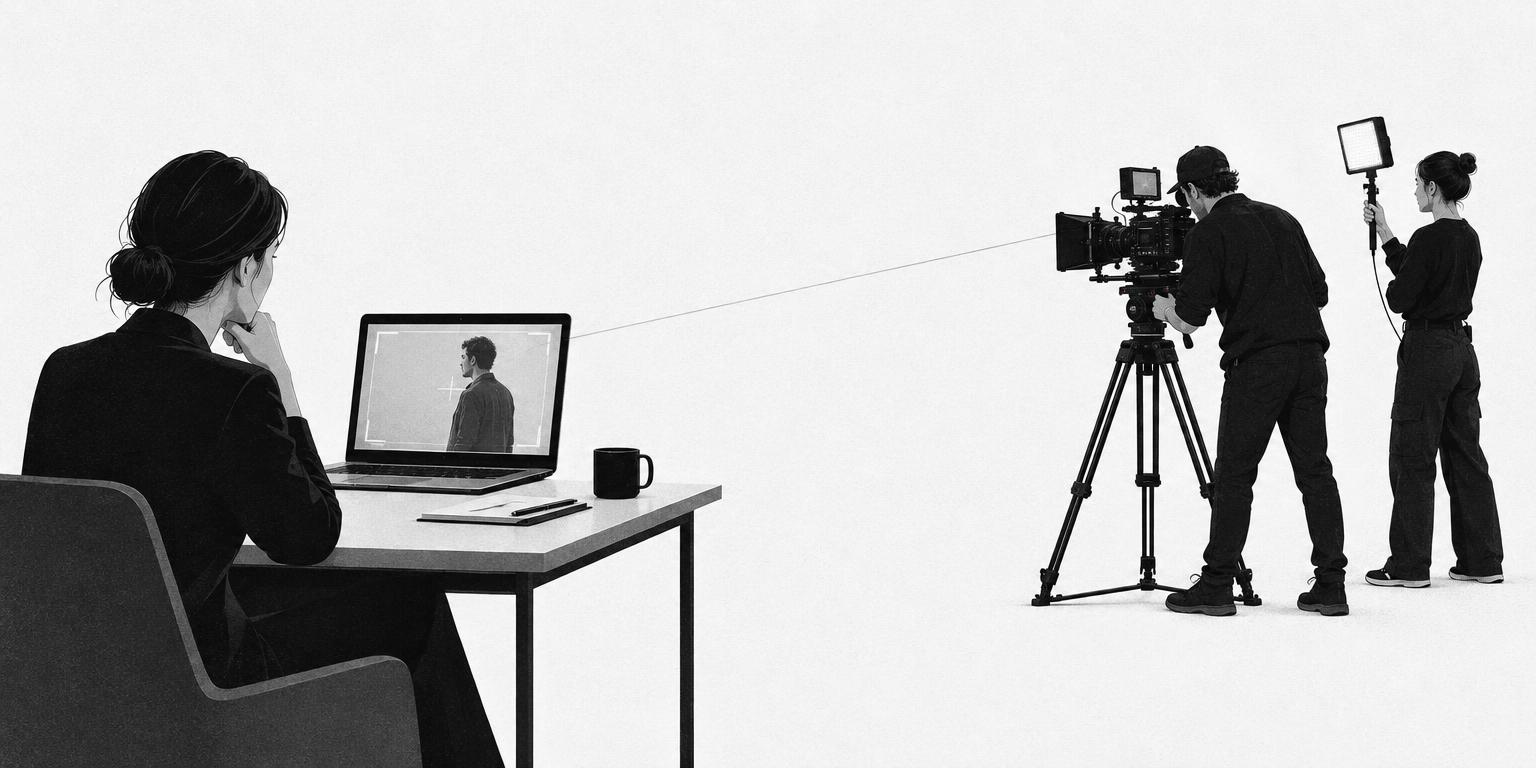
On set, the video village is the cluster of monitors where the director and client watch what the camera sees. A remote video village sends that feed over the internet to you, live, so you can approve framing, performance and takes from another city. It is the thing that turns "trusting strangers" into "watching the monitor," and it is how Spexster runs remote productions as standard. Crews have preferred tools, so ask which they use and whether it is included in their rate:
- QTAKE Monitor lets you "supervise your production remotely using secure live stream from set or watch the best takes" on iPhone, iPad, Mac, Apple TV and Apple Vision Pro, with two-factor authentication, end-to-end encryption and watermarking.
- Sohonet ClearView Flex is built to "stream live, encrypted video to your crew, creatives or clients straight from the camera or video village," with sub-100ms latency, end-to-end encryption and up to 40 participants in a session.
- Teradek Core is a cloud platform that lets you "preview and monitor your live and recorded video feeds" from Teradek encoders, with latency the company puts at as low as 200ms.
- Frame.io Camera to Cloud is a different kind of tool: rather than a live feed, it will "automatically upload photos, video, and more from your device to Frame.io" as you shoot, so each take can be reviewed minutes after the camera stops, from cameras and devices by Atomos, Canon, Fujifilm, Nikon, Panasonic LUMIX, RED, Teradek and others.
Three habits make it work: test the feed from the actual location the day before, since venue connectivity varies; keep an open voice line separate from the video feed; and have one person on your side give notes.
Legal and logistics differences across cities and countries
Permits. Filming in public space in large cities is generally handled by a city film office; FilmLA, for example, calls itself the official film office of Greater Los Angeles, and Toronto runs permitting through the City's Film Office. Lead times, fees and what triggers a permit differ by city; a local crew knows which applies. The city hubs for New York, Toronto, Vancouver and London are where to find crew who work under those rules every week.
Insurance. Venues and permit offices commonly ask for a certificate of insurance naming them as an additional insured. Agree whose policy issues it and allow time.
Releases. Anyone identifiable on camera signs an appearance release; private locations sign a location release. Have templates reviewed if the footage will run in several countries.
Matching footage across cities
Multi-city campaigns fail in the edit when each crew shot to its own defaults. Send every crew the same spec:
- The same shot list, numbered identically, so shot 7 in Atlanta is shot 7 in Toronto.
- Recording settings. Resolution, codec and one frame rate for the whole campaign.
- Colour pipeline. The camera's log profile plus one monitoring LUT for every crew; tell your colourist early if camera brands differ.
- Framing and slate conventions. Interview focal lengths, headroom, eyeline alternation, and scene/take numbering with the city identified.
- Audio. Sample rate, lavalier plus boom or lavalier only, room tone at each location.
- Deliverable spec. File naming, checksum verification on offload, cloud destination, first-upload deadline, and two copies before the crew leaves.
One person owns this document and signs off each city's first upload before that crew wraps.
Payment and contracts
A crew in another city is a vendor you may never meet, so the paperwork does the trust work. Cover shoot date and hours, overtime, deliverables and spec, delivery dates, rights (a licence or a written assignment, in writing), cancellation and weather terms, and the payment schedule.
The common structure is a deposit to secure the date and the balance on delivery. Escrow, where funds are held by a third party and released when the agreed work is delivered, is better for exactly this situation: the crew knows the money exists, and you are not paying in full for footage you have not seen. With several crews, use one payment structure on every contract.
The remote shoot checklist
Before you book: deliverables and where they will run; numbered shot list and references; technical spec (frame rate, codec, log profile, LUT, slate, audio); named approver and how the crew reaches them; contract with rights, cancellation and payment schedule, deposit paid.
Before the camera rolls: call sheet with shot list attached; remote video village tested from the location the day before; permit, insurance certificate and release templates on file; two copies of footage before leaving set; first-upload review booked.
How Spexster fits
Everything above is how to do it yourself, and brands do. Spexster exists because most would rather not, and because the hard part of a remote shoot is not any one step but doing all of them in a city you do not know.
Spexster is a global film, video and photo production platform that connects brands and agencies with vetted creative professionals worldwide, founded by two commercial filmmakers, John Kubin and Jed Williams. Every professional is vetted before appearing: Spexster confirms they are a real, working professional and reviews their portfolio, credits and professional presence, with no paid placement. For a shoot in another city or country, post a job and local professionals apply to you, so the "crew you have never met" has already read your brief and wants the work. Or send one brief and a dedicated White Glove project manager handles crew sourcing in each location, technical briefings, contracts, scheduling, logistics and secure escrow payment at no additional fee, with a live remote video village so you direct from your desk. Payments run through escrow powered by Stripe and are released when work is delivered.
This is the pattern behind two of our favourite projects. Madden Media hired crew across four US locations using local people in each destination. DIVE Billboards used Spexster crews in 13 countries and more than 45 cities. Browse videographers and cinematographers by city to start.
Frequently asked questions
Is it cheaper to hire a local film crew or fly my own crew to another city?
For most shoots of one to three days, local is cheaper once you add airfare, hotels, per diems, travel days, equipment transport and, across a border, customs paperwork. Fly your own team only when one director's continuity outweighs that.
How do I direct a shoot I am not physically at?
Through a remote video village: a live, low-latency stream of the camera monitor sent to your laptop, tablet or phone over a tool such as QTAKE Monitor, Sohonet ClearView Flex or Teradek Core, with an open voice line to the crew, plus a camera-to-cloud upload so each take can be reviewed minutes after it is shot.
How far ahead should I book a crew in another city?
Allow a few weeks for a straightforward shoot, longer if public-space permits, street closures or talent are involved, since film-office lead times vary by city.
How do I make sure footage from different cities matches?
Send every crew the same written spec: identical shot list numbering, one frame rate, the same log profile and LUT, agreed framing and slate conventions, and the same file naming. Review each city's first upload before that crew wraps.
Who handles permits and insurance when I hire a crew remotely?
Agree it in the contract. Permits usually run through a city film office and venues often want a certificate of insurance; a local crew knows the process, but who pays fees and whose policy issues the certificate is up to you both.